Open sea
Technology · Harvest

Four ways to take
what the sea and the road give

One patent-granted wave converter, one patented hybrid system, and two machines that extend the same thinking to sun, wind and traffic.
01 — Wave energy converter

Wave Daedalus

A converter that turns the force of waves into clean electricity — designed for the highest possible yield at the lowest possible build cost.

We named it after the mythical craftsman because it was built the way he worked: observe, correct, rebuild. It was developed through a long period of research in real sea conditions, not in tanks with artificial waves, because the energy potential of a real sea is the only thing worth designing against.

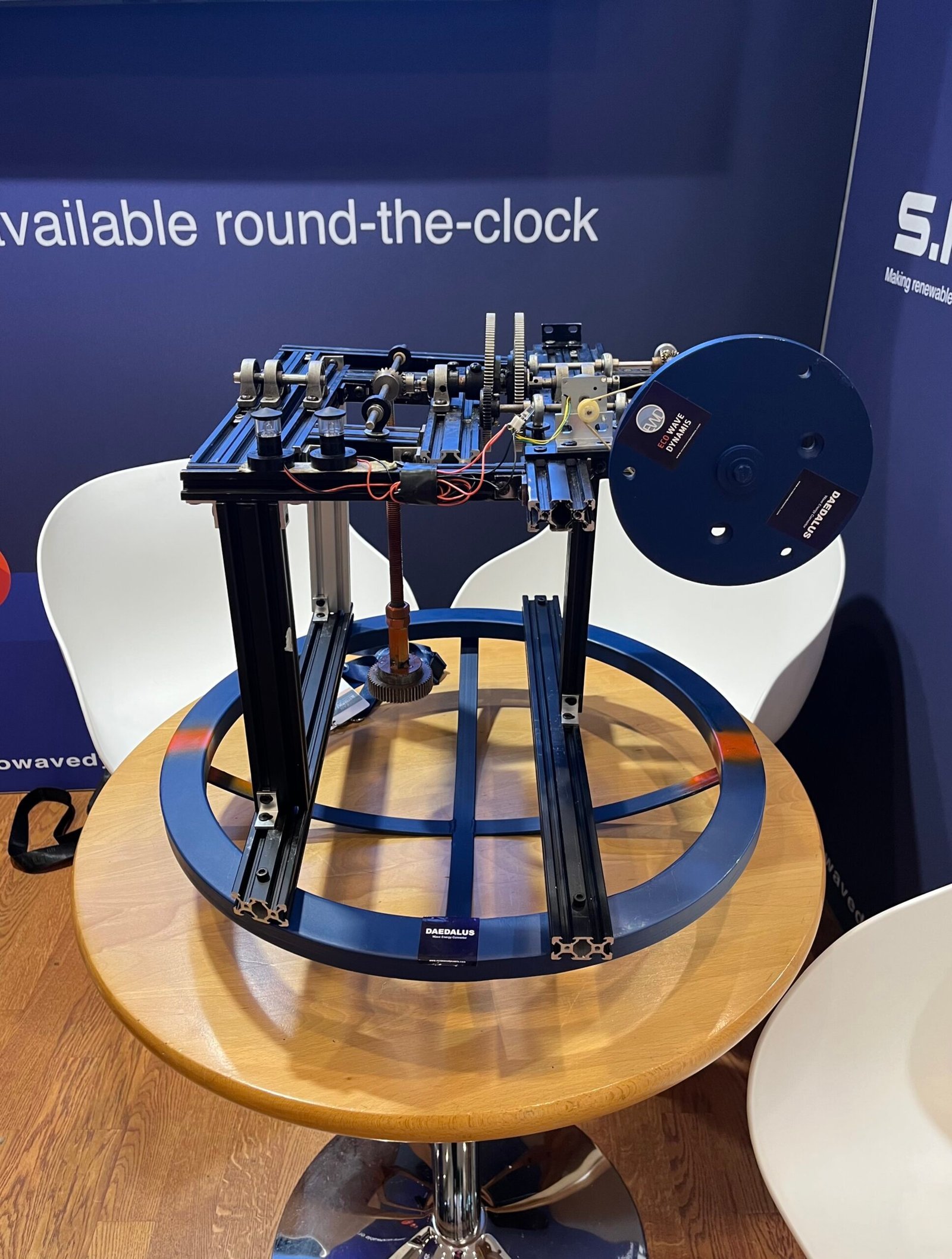
The mechanism works on the principle of the free gyroscope — a flywheel free to move on all three axes. The float is connected to the gyroscopic mechanism by a strong lever, which converts the float's free movement into rotation.

The Wave Daedalus gyroscopic mechanism prototype
Advantage 01

It follows the wave, in any direction

The float follows whatever direction the wave takes, so the system exploits both the potential and the kinetic energy of the wave. Existing installed systems only rise and fall, which leaves most of the wave's energy on the table.

Advantage 02

It measures the wave while it works

The only wave converter in the world that measures wave height to the centimetre, by applying the Pythagorean theorem. The machine that harvests the sea is also the instrument that reads it.

Advantage 03

Built for the worst weather

Hydrostatic forces, bending moments and overturning moments were designed for from the start, so operation is guaranteed even in the most adverse conditions.

Advantage 04

Simple enough to be reliable

The simplicity of the system makes it ergonomic and dependable, with low maintenance needs — which is what makes it a safe source of return for an investor.

Advantage 05

A bulbous float

The float is bulbous in shape so that it absorbs and minimises the impact forces of the wave rather than fighting them.

Advantage 06

It can be lifted out

Easily removed from the water when needed — for maintenance, for storage out of season, or to protect it from extreme weather.

Specification

Output range0.5 kWh to 100 kWh, built to size for the client's demand
PrincipleFree gyroscope — three-axis flywheel driven by a lever from the float
SitingAny coast where waves reach; shore, jetty, precast block or vessel
MaintenanceLow, by design. Support from the same people who designed and built it
Service lifeLong, with straightforward removal for storage or protection
MeasurementWave height to centimetre resolution, integral to the machine

Where it is used

A small-footprint mechanism that can be placed on any coast and cover the green electricity needs of seaside homes, hotels, campsites, restaurants and any other installation beside the sea.

AutonomyFull or partial energy autonomy for coastal homes
HospitalityPart of the electricity demand of seaside hotels and campsites
Public lightingMarinas and coastal roads
WaterPool replenishment pumps; continuous supply to fish farms; desalination
MobilityEV charging stations, combined with wind turbines and/or photovoltaics
ScienceEnergy autonomy for marine recording and transmission devices in low-sunlight areas
02 — Hybrid generation and storage

Smart Hybrid Energy System

Making renewable energy available round the clock. A patented system that integrates solar, wind and wave capture with compressed-air storage and a flywheel generator.

Renewable systems have one structural weakness: their output depends on the variability of the resource. Keeping a grid stable usually means falling back on internal-combustion generators. S.H.E.S. is our answer to that.

S.H.E.S.
Capture

Harvesting the resource

Solar panels absorb sunlight, wind turbines take the wind, and wave energy converters exploit the force of ocean waves — all feeding one system.

Store

Compressed-air chambers

The distinguishing feature. When there is surplus energy — a very sunny or windy day — the excess is used to compress air, which is then stored in chambers.

Release

Energy on demand

When demand exceeds what the renewables can supply directly, the compressed air is released into the generating units, so supply stays stable when the resource is scarce.

Smooth

The Volan system

At the heart of S.H.E.S. A motor-driven flywheel working alongside a generator: released air drives the motor, the flywheel spins, and that rotational energy is converted back into electricity — storing kinetic energy and smoothing out fluctuations.


Integrated AI

Predictive forecasting and dynamic management

Algorithms analyse historical data, weather patterns and demand trends to anticipate when renewable supply will be abundant. The system simultaneously monitors generation, consumption and storage levels in real time, allowing dynamic adjustment and management of when compressed air is released.

Integrated AI

Real-time information and alerts

The system issues significant alerts as they happen — informing operators immediately of low stored-power levels, or predicting drops in output based on forecast conditions, so decisions can be made early enough to matter.

03 — Hybrid solar and wind unit

Aurora

A hybrid generating unit that exploits both the sun and the wind, and connects to everything else we build.

  • Draws on solar and wind according to the prevailing weather.
  • Equipped with folding blades for more efficient and safer use of wind energy.
  • Captures solar energy at the same time.
  • Portable as a small unit; buildable at larger scale for higher demand.
  • Connects to wave energy converters sited close to shore.
  • Installs on moving or stationary vessels, maximising generation from waves, wind and sun together.
  • Connects to Road Energy for electricity generation on motorways.
AuroraPowered by Lever Dynamis
04 — Kinetic harvesting

Road Energy

Takes the mechanical energy of vehicles and turns it into electricity — without the driver ever noticing.

Road Energy is built on a piezoelectric harvesting mechanism combined with machine-learning techniques. The transducers exploit the kinetic energy of moving cars, collecting the maximum yield from each vehicle according to its mass and weight. That energy is carried from the transducers to a central unit through an innovative hydraulic system.

What separates it from similar technologies is that hydraulic mechanism: it produces electricity continuously and without disturbance, because it needs no special road ramps, no reduction in speed and no other interruption to the driving experience.

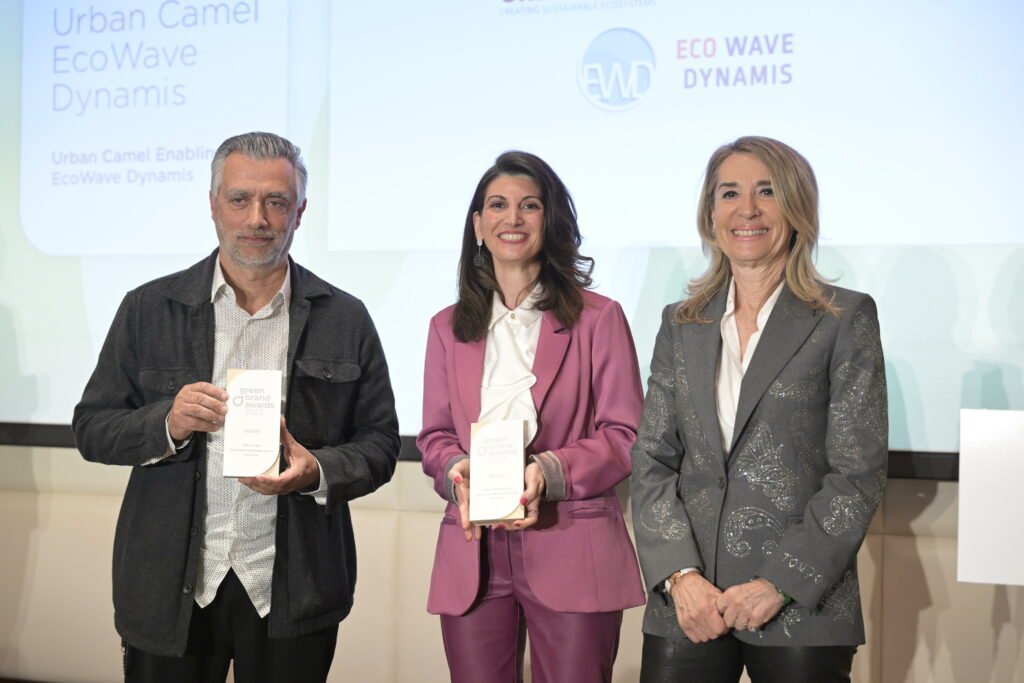
The technology was recognised with the Silver Award for Green Start-up at the Green Brand Awards 2023, presented with our strategic partner Urban Camel, who mapped the technology, its applications and its contribution to the UN Sustainable Development Goals.

Output80,000–100,000 kWh per year from a single unit
MechanismPiezoelectric transducers + hydraulic transfer to a central unit
Driver impactNone. No ramps, no speed reduction, no disturbance
SitingPorts, airports, hospitals, schools, toll stations
MonitoringTracks traffic and road temperature, contributing to safer and more sustainable mobility
RecognitionSilver Award Green Start-up, Green Brand Awards 2023
Lever Dynamis and Urban Camel receiving the Green Brand Awards Silver Award in 2023
Next

Every one of these machines produces data

Epignosis is the layer that reads it — turning the real behaviour of a floating converter into something you can evaluate, predict and improve.

Explore Epignosis →